
Table of Contents
- How Gift Card Draining Scams Actually Work
- Signs of a Gift Card Scam: What to Check Before You Buy
- Where to Safely Buy Gift Cards (and Where to Avoid)
- Why You Should Never Pay Bills With Gift Cards
- How to Report Gift Card Fraud and Get Help
- How to Sell Unused Gift Cards for Cash Safely
- Protecting Your Gift Card Information Going Forward
- Frequently Asked Questions
Last Updated: September 16, 2026
How Gift Card Draining Scams Actually Work
Gift card draining is a form of fraud where a thief steals the funds from a gift card before the recipient ever gets to spend them. Learning how to avoid gift card scams starts with understanding that the card in your hand may already be empty. This guide breaks down exactly how these schemes operate, what to look for, and what to do if you get caught.
The Barcode Overlay Trick
Thieves peel the original barcode sticker off a gift card and replace it with a counterfeit barcode linked to a card they already control. When a cashier scans it at checkout, the activation amount loads onto the thief’s card instead of yours. You walk out with a card that has a balance of zero, and the receipt proves you paid.
PIN Exposure and Scratch-Off Panel Tampering
Many cards hide the redemption PIN under a scratch-off panel. A common tactic is to carefully lift that panel, photograph the number, then reseal it so the tampering is invisible. Once the card is activated, the thief redeems the balance online within minutes. A scratched or resealed panel is one of the clearest signs of a gift card scam.
The Timing of a Drain
The drain usually happens in the window between activation and first use. A thief who has already captured the card number and PIN can set up an automated balance check that triggers the moment the card is funded. In practice, the balance can be gone within seconds to minutes of activation. This is why buying a card and letting it sit unused for weeks is risky, the longer the gap, the wider the window.
How to Visually Identify a Compromised Card
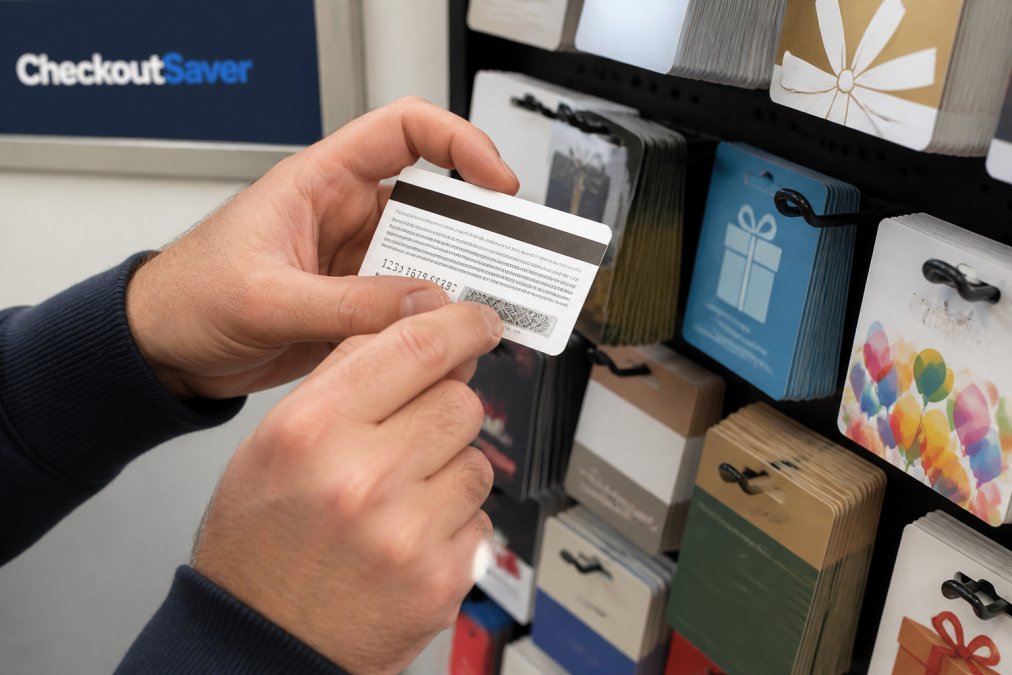
Before you buy, compare the card in your hand to the cards beside it on the rack:
- Barcode: Printed directly on the card, not a sticker with a visible edge or bubble.
- Scratch-off panel: Intact, opaque, and consistent in color with the rest of the card.
- Packaging: Sealed, with no signs of being opened and resealed.
- Card thickness: Consistent with neighboring cards; an overlay adds a slight bulge.
- PIN: Not visible without scratching.
A card that looks fine on the shelf can still be compromised if the thief captured the number and PIN earlier and is waiting for activation. Buying from a store’s own rack and checking the balance immediately after purchase are your best defenses.
Signs of a Gift Card Scam: What to Check Before You Buy
The most reliable way to spot a compromised card is to inspect the packaging and the card surface before you pay. A few seconds of checking prevents most losses.
Physical Tampering Red Flags
Run through this checklist at the shelf:
- The barcode sticker is crooked, bubbled, or looks different from cards beside it
- The scratch-off panel is scratched, cloudy, or appears resealed
- The packaging looks opened, resealed, or has a damaged security seal
- The card feels thicker than normal, which can indicate a barcode overlay
- The PIN is already visible without scratching
Any single item on this list is reason enough to put the card back and pick another.
Digital Gift Card Warning Signs
Digital cards carry their own risks. A common mistake is buying a discounted digital gift card from a third-party seller on a marketplace or social platform. If the price is far below face value and the seller pressures you to pay through an untraceable payment method, that’s a red flag. Stick to cards issued directly by a reputable retailer or a platform that verifies its sellers.
Buying a gift card from a stranger on social media is one of the fastest ways to lose money. Once you send payment, you have no proof of purchase and no way to reverse the transaction.
Where to Safely Buy Gift Cards (and Where to Avoid)
The safest place to buy a gift card is directly from the retailer or from a platform that verifies every seller and stands behind the transaction. Buy in person from the store’s own rack, or online from the brand’s official website. Verifying the legitimacy of these sources remains a fundamental pillar of safe online shopping, which requires a broader understanding of how to protect your financial information across all digital storefronts.
Avoid these sources:
- Marketplace listings from individual sellers with no feedback history
- Cards sold at a steep discount by strangers on social platforms
- Racks in high-traffic stores where cards sit unattended for long periods
- Any seller who insists on payment through gift cards, wire transfer, or crypto
Why You Should Never Pay Bills With Gift Cards
No legitimate government agency, utility, or business accepts gift cards as payment for a bill (Avoiding and Reporting Gift Card Scams). This is the single most important rule in this guide.
If anyone asks you to pay a debt, fine, or bill with gift cards, it is a scam. Hang up and verify the claim by calling the organization directly using a number you look up yourself.
How to Report Gift Card Fraud and Get Help
Act fast, because the first hours matter most. Gift card fraud is a race: the thief typically drains the balance within minutes of activation, so the sooner you report, the better your odds of a freeze or partial recovery. Report to the card issuer, the retailer, and the authorities as soon as you realize what happened.
Step-by-Step Reporting Sequence
- Call the gift card issuer first. Use the customer service number printed on the back of the card or on the issuer’s official website. Ask them to freeze the card and flag the transaction. Have your receipt, the card’s serial number, and the approximate time of purchase ready. Issuers can sometimes see where and when the balance was redeemed, which helps build a paper trail.
- File a report with the FTC at ReportFraud.ftc.gov. The FTC does not resolve individual cases, but it feeds complaints into the Consumer Sentinel Network, a database used by thousands of law enforcement agencies. Your report may connect to a larger pattern.
- Contact your state attorney general’s office. Many state AGs have consumer protection divisions that pursue gift card fraud cases and can sometimes mediate with retailers. Find yours through the National Association of Attorneys General directory.
- File a local police report. A police report creates an official record that issuers and retailers often require before they will consider reimbursement. Ask for the report number.
- Notify the retailer where the card was purchased. Store-level loss prevention teams sometimes have camera footage of the shelf and can identify when a card was tampered with.
- Contact your bank if you paid with a credit or debit card. Some credit cards offer purchase protection that may cover a drained gift card, though this varies by issuer and is not guaranteed.
What to Have Ready Before You Call
Having these items on hand speeds up every report:
- The physical card (even if drained) and its serial number
- The original purchase receipt or a bank/credit card statement showing the purchase
- The date, time, and store location of purchase
- Any communication from the scammer (texts, emails, phone numbers, screenshots)
- The card’s original balance and the date you discovered it was empty
Realistic Recovery Expectations
Recovery is difficult and often incomplete. A common pattern is that issuers reimburse only when the cardholder can show proof of purchase and evidence the card was drained through fraud rather than lost or given away. Many cases end without a refund, especially when the card was purchased with cash and no receipt was kept. The FTC’s Consumer Sentinel data consistently shows gift card fraud among the top reported fraud categories, which means issuers see high volumes and apply strict documentation standards.
Report within 24 hours if possible. The longer you wait, the harder it is for the issuer to trace the redemption and the less likely any reimbursement becomes.
How to Sell Unused Gift Cards for Cash Safely
Selling a card you won’t use is a smart way to recover value, but the process has its own traps. The safe approach is to sell through a verified platform, keep your receipt and serial number, and confirm the buyer’s payment clears before you hand over the card details.
Here’s what to watch for:
- Never send the card number and PIN before you’re paid. Once the buyer has the code, they can drain it.
- Use a platform that holds the transaction until both sides are satisfied.
- Keep a record of the card’s serial number, original balance, and proof of purchase.
- Check the balance yourself right before the sale so you can prove the card was funded.
Protecting Your Gift Card Information Going Forward
Treat a gift card like cash. Once the balance is gone, it’s gone, and there’s no chargeback to save you.
A few habits go a long way:
- Photograph the card’s front, back, and serial number, then store the image somewhere secure.
- Keep the receipt until the balance is fully spent.
- Check the balance regularly using the issuer’s official number or website, not a link from an email or text.
- Register the card with the issuer if that option exists, which can help if it’s lost or stolen.
- Never share the card number or PIN with anyone who contacts you first.
If you plan to give a gift card, buy it close to the date you’ll hand it over. The longer a card sits activated but unused, the more time a thief has to drain it.
Frequently Asked Questions
How do I know if my gift card has been scammed?
Check the balance immediately after buying and keep your receipt. If the balance is zero or lower than expected, the card may have been drained. Look for signs of tampering like a peeled-back scratch-off panel, a barcode sticker placed over the original, or a security seal that looks disturbed. Report the issue to the retailer and card issuer right away with your receipt and the card’s serial number.
Are digital gift cards safer than physical ones?
Digital gift cards avoid physical tampering risks like barcode overlays and scratch-off panel damage, but they have their own vulnerabilities. Phishing emails and social engineering attacks often target digital gift card codes. Buy digital cards only from official retailer websites or trusted platforms, never from third-party sellers on marketplaces. Store codes in a secure password manager and avoid sharing them over email or text.
What should I do if I paid a scammer with a gift card?
Contact the gift card issuer immediately and report the fraud. Provide your receipt, the card’s serial number, and any communication with the scammer. File a report with the FTC at ReportFraud.ftc.gov and your local police. Unfortunately, gift card payments are difficult to reverse once the funds are drained, which is why scammers prefer them. Acting fast gives you the best chance of recovering any remaining balance.
How can I safely sell unused gift cards for cash?
Use a reputable platform that verifies card balances before listing and offers buyer protection. Avoid selling to strangers on social media or classified sites where you have no recourse if the transaction goes wrong. Before selling, check the card’s balance, keep a record of the serial number, and confirm the platform’s fees and payout process. Legitimate services typically take a percentage but provide transparency and dispute resolution.
Gift card fraud keeps evolving, and the thieves count on you being in a hurry. Slowing down at the shelf and knowing the red flags is most of the battle. When you’re ready to buy discounted cards or turn unused ones into cash, Checkout Saver gives you one-time use coupon trading, discounted gift cards, and cashback in one transparent place with no hidden codes. Sign up free and start keeping more of your money in your pocket.

