
Table of Contents
- Why Used Gift Cards Are a $100 Million Problem
- Gift Card Scam Red Flags to Spot Before You Buy
- How to Check Gift Card Balance Safely Before You Pay
- Digital vs. Physical Cards: Which Risk Profile Fits You?
- Best Sites to Buy Discounted Gift Cards (and What to Avoid)
- What to Do If You Buy a Compromised Card: Reporting and Recourse
- Frequently Asked Questions
Last Updated: September 18, 2026
Why Used Gift Cards Are a $100 Million Problem
Buying a used gift card can be safe, but only when you buy from a source that verifies the balance and stands behind the card. The risk is real: a card can be drained before you ever reach the register, and once the funds are gone, recovery is difficult. This guide from Checkout Saver breaks down exactly where the danger lives, how to spot tampering before you pay, and which habits separate a smart discount from a costly mistake.
Gift Card Scam Red Flags to Spot Before You Buy
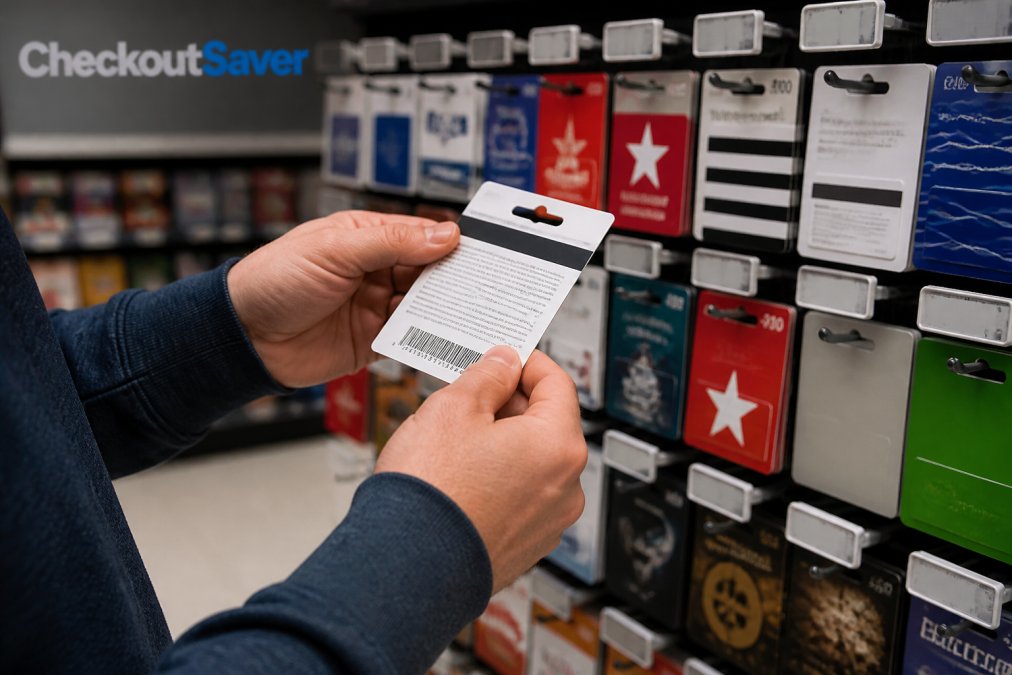
The clearest red flag is a card that has been physically altered in any way. If the packaging looks resealed, the barcode has a sticker over it, or the PIN panel has been scratched, put it down. Those are not cosmetic issues; they are the fingerprints of a drained card.
Physical Tampering: Barcode Stickers and Security Seals
Barcode manipulation works like this: a scammer copies the card’s real barcode, then sticks a duplicate barcode sticker over the original. When you buy the card, the register activates the scammer’s barcode instead of yours. You walk out with a card that has already been loaded onto someone else’s account.
Check three things before you pay:
- The security seal is intact and not re-glued
- The barcode is printed on the card, not a sticker layered over it
- The PIN scratch-off panel is untouched
Pricing Psychology: Why Deep Discounts Are a Warning Sign
A legitimate discount on a gift card is usually modest. When someone offers a card at a steep markdown, ask why. The “too good to be true” price is the oldest signal in the book, and it applies here more than almost anywhere.
Never buy a gift card from a seller who pressures you to complete the transaction off-platform or pay with another gift card. That request is itself the scam, and once you send the payment, the funds are gone.
How to Check Gift Card Balance Safely Before You Pay
Most guides stop at “check the balance.” That advice is useless without knowing when and how to check, because a gift card’s balance can read one way at the moment of sale and a very different way an hour later. The verification gap is where used-card buyers get burned.
Why Timing Matters More Than the Number on the Screen
A balance check is a snapshot, not a guarantee. Two mechanics trip up used-card buyers:
- Activation lag. Many retailers do not load funds onto a card until the register scans it at checkout. A card that was never activated will show a zero or error balance even though it looks brand new. If a reseller hands you a card that reads “not activated,” that is not a green light, it is an unresolved question.
- Post-sale draining. A thief who has already copied a card’s number and PIN can wait until the card is funded, then spend it within minutes. A balance that reads $100 today can read $0 tomorrow. This is why a screenshot from last week proves nothing.
How to Run an Official Balance Check, Step by Step
- Find the issuer’s official balance page or phone number. It is printed on the back of the card or listed on the retailer’s own website, not a search-ad result.
- Enter the card number and, if prompted, the PIN or security code from the scratch-off panel.
- Confirm three things: the card is active, the balance matches the amount you are paying for, and the card has not been reported lost or stolen.
- Re-check within minutes of completing the purchase, and again immediately after you receive the card in hand.
Ask the seller for a screenshot of the current balance from the issuer’s official page, timestamped that day. A legitimate seller will provide it without hesitation. A scammer will stall, make excuses, or push you to hurry. Better yet, run the check yourself on a call with the seller still present.
Official Balance Checkers vs. Third-Party Tools
A third-party balance tool is fine for a rough estimate, but it is not proof. Only the issuer can confirm a card is active, funded, and unclaimed. Third-party tools also cannot see activation status, which is the single most common reason a used card fails at the register. If a seller will not let you verify the balance through the issuer before you pay, walk away.
No balance check protects you from a card that is drained after you verify it. The only real protection is buying from a source that holds the seller’s funds until you confirm the card works, not one that hands over the code the moment payment clears.
Digital vs. Physical Cards: Which Risk Profile Fits You?
Digital gift cards carry a lower tampering risk because there is no physical barcode to manipulate and no shelf for a thief to work from. The trade-off is that a digital code can be copied and used the instant it is shared, so the risk shifts from the store to the transaction itself.
| Card Type | Main Risk | Safer When |
|---|---|---|
| Physical (retail rack) | Barcode tampering, drained cards | Bought directly from the retailer |
| Physical (resale) | Compromised card, no recourse | Seller verifies balance first |
| Digital | Code copied before you use it | Bought from an authorized source |
| Digital (resale) | Activation code already redeemed | Never, unless verified by issuer |
Best Sites to Buy Discounted Gift Cards (and What to Avoid)
The best sites to buy discounted gift cards are ones that verify balances, hold funds until the card is confirmed, and offer a real refund policy. That combination is what separates a trustworthy marketplace from a gamble.
What to avoid:
- Online auction sites and social media marketplaces, where there is no verification and no recourse
- Any seller who insists on payment outside the platform
- Listings priced far below the card’s face value Maintaining this level of vigilance is essential for safe online shopping, a principle that remains equally critical when navigating the complexities of purchasing apparel through digital storefronts.
What to Do If You Buy a Compromised Card: Reporting and Recourse
Act fast. Report the drained card to the issuer first, then to the platform or retailer where you bought it, and keep every receipt and screenshot. Speed matters because funds that have already been spent are rarely recovered. But “report it” is where most guides end, and that is exactly where the useful part begins.
The Order of Operations That Actually Works
- Call the issuer’s fraud line, not the general customer service number. Ask for a “gift card fraud investigation” by name. Provide the card number, the date and place of purchase, and your receipt. The issuer can freeze the remaining balance and flag the card.
- File a report with the Federal Trade Commission at ReportFraud.ftc.gov. The FTC does not resolve individual cases, but its reports feed the pattern data that drives enforcement, and the confirmation number is useful evidence elsewhere.
- Notify your state attorney general’s consumer protection office. Many states maintain their own gift card statutes and complaint portals, and a state-level complaint can carry more weight with a retailer than a single phone call.
- Dispute the charge with your payment method, if you paid by credit card. This is the step most people get wrong, so read the next section carefully.
The Chargeback Gap Nobody Explains
Here is the honest truth most guides skip: gift cards are treated differently from ordinary merchandise, and the protections you expect do not always follow.
- Credit card chargebacks. Under the Fair Credit Billing Act, you generally have the right to dispute charges for goods you did not receive as described. Whether a drained gift card qualifies depends on the issuer, the seller, and how the transaction was coded. File the dispute anyway and describe the card as “not as described”, but expect the seller to argue that gift cards are non-refundable.
- Debit cards and bank transfers. Dispute rights are weaker and timelines are shorter. If you paid by peer-to-peer transfer or a wire, recovery is close to impossible.
- Paying with another gift card. This is the worst case. Gift-card-to-gift-card payments are generally irreversible, and no chargeback right attaches. If a seller asked you to pay this way, that request was the scam.
When It Is Worth Filing a Police Report
A police report rarely recovers a single drained card on its own, but it does two things: it creates an official record you can attach to an issuer investigation or a small-claims filing, and it contributes to the pattern evidence that turns individual complaints into enforcement action. File one if the loss is significant, if you have the seller’s identity or account handle, or if the platform refuses to cooperate.
The realistic outcome for most victims is partial or no recovery. That is not pessimism, it is the reason prevention beats recovery every time. The single highest-leverage protection is buying only from a source that verifies the balance through the issuer and holds the seller’s funds until you confirm the card works.
Frequently Asked Questions
What is the safest way to purchase a gift card?
Buy directly from the retailer or an authorized seller, and pay with a credit card so you have chargeback rights. If you buy secondhand, use a platform with buyer protection and verify the balance through the retailer’s official balance checker before completing the purchase. Avoid cards sold through online auctions or social media, where barcode tampering and stolen funds are common.
Can I get money back if scammed by a gift card?
Recovery depends on how you paid. Credit card purchases may qualify for a chargeback under the Fair Credit Billing Act, but gift cards bought with cash or debit are rarely refundable. Report the fraud to the FTC at ReportFraud.ftc.gov and file a complaint with your state attorney general. If the card came from a retailer, their policy may offer a replacement, though many exclude third-party purchases.
How can you tell if a gift card has been scammed?
Check for a barcode sticker placed over the original barcode, a scratched-off PIN panel, or packaging that looks resealed. Verify the balance using the retailer’s official checker before buying. If the balance is zero or lower than expected, or if the activation code was already redeemed, the card is likely compromised. Keep your receipt and transaction history as proof.
Are there consumer protections for gift card purchases?
Federal protections cover some gift card terms, including limits on expiration dates and fees under the CARD Act. They do not cover fraud losses on secondhand cards. Consumer protection depends heavily on the seller’s policy. Authorized retailers and reputable resale platforms often offer buyer protection, while peer-to-peer sales leave you with little recourse beyond reporting the scam.
Buying used gift cards does not have to be a gamble, but it does require discipline: verify the balance through the issuer, buy only from platforms that back the card, and treat a deep discount as a question, not a green light. Checkout Saver was built for exactly this kind of shopper, offering discounted gift cards, one-time use coupon trading, and cashback with no hidden codes, so you can pay less without wondering whether the card will work. Sign up free and start saving with confidence.

