
Rakuten can pay you cash for buying something you were already going to buy because, in many cases, the retailer is paying Rakuten first. Here’s where that money comes from, how affiliate tracking works, and why retailers are willing to pay for it.
Short answer
Rakuten primarily makes money on its cashback shopping service by earning commissions from retailers for sending them customers.
When you activate Rakuten Cash Back and then make an eligible purchase, the retailer pays a referral or affiliate commission for that sale. Rakuten shares part of that payment with you as Cash Back and retains part of the economics of the transaction.
Retailers are willing to pay because the commission is essentially a marketing/customer-acquisition expense tied to a measurable shopping action.
Rakuten can also receive compensation from merchant partnerships and promotional arrangements. And Rakuten Rewards is only one part of the much larger Rakuten Group, which operates businesses spanning e-commerce, financial services, advertising, communications and mobile service.
This is also the fundamental model behind most cashback websites, including Checkout Saver: merchants pay for referred sales, and a large portion of the resulting affiliate commission can be returned to the shopper.
You buy a $100 pair of shoes. The retailer gets the sale. Rakuten gives you, say, $5 back. You didn’t pay Rakuten anything.
So where did the $5 come from?
If you’ve ever wondered how does Rakuten make money while handing cash back to shoppers, the short version is: generally from the marketing economics behind the transaction—not from a fee you pay at checkout.
Retailers routinely spend money acquiring customers through Google and search advertising, social ads, influencers, email partnerships, loyalty programs, and affiliate / cashback publishers. With affiliate and cashback marketing, compensation can be tied directly to a completed purchase. That is the key to understanding the model.
How Does Rakuten Make Money?
Rakuten’s own help documentation describes the cashback service in straightforward terms. In its Advertising Disclosure, Rakuten explains that when you follow its links to visit a merchant, that merchant pays Rakuten a commission on what you buy during the visit. Rakuten then shares that commission with members as Cash Back.
Rakuten also states that merchants may pay to partner with the service because it sends shoppers to their websites or stores, and that merchants may also pay Rakuten to help grow their brand or acquire new customers—including through features on Rakuten properties such as the website or emails.
Its How Rakuten Works page puts the same idea even more directly: stores pay a commission for referring shoppers; Rakuten keeps a portion of that commission and shares the rest with members as Cash Back.
What we cannot responsibly claim—because Rakuten does not publish it as a fixed public figure—is the exact margin on any individual transaction. Commission rates, promotional boosts, exclusions, and publisher economics vary by merchant and over time.
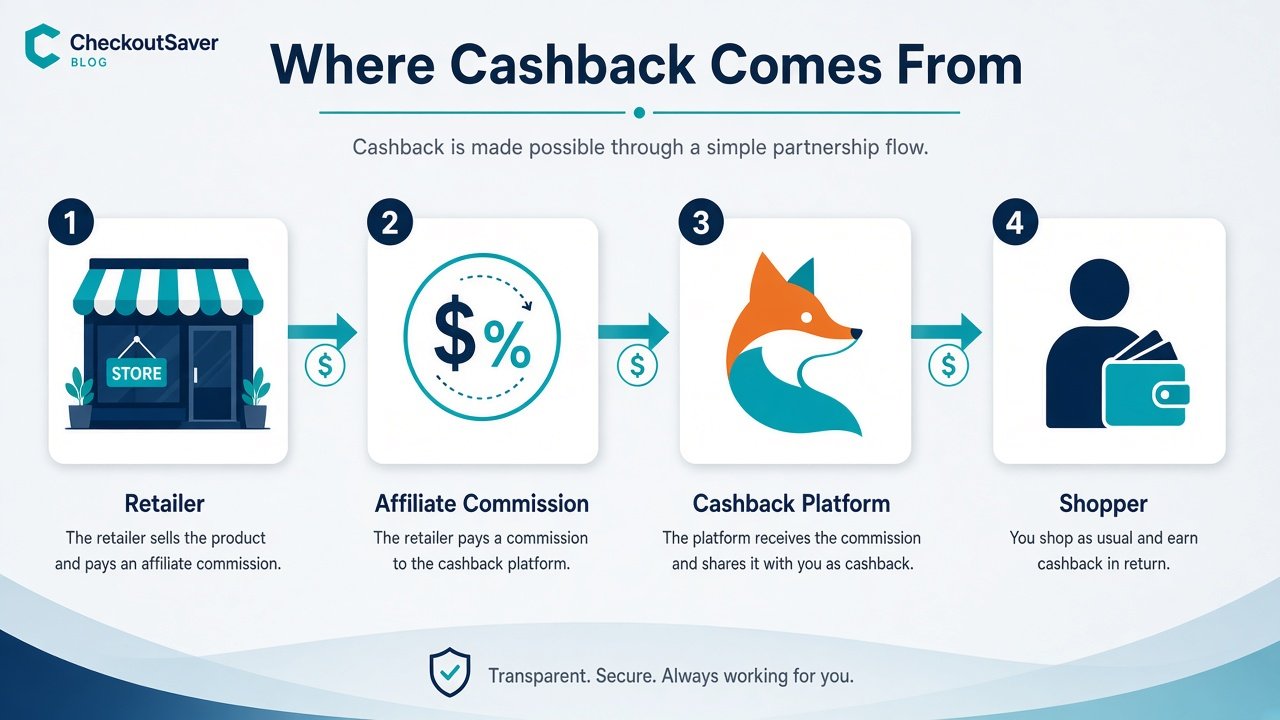
Follow the Money: How a Cashback Purchase Works
Here is the money flow in plain language:
Where does your cashback actually come from?
Affiliate commission
Cashback service
Shopper
A concrete hypothetical example helps. These numbers are teaching illustrations—not claimed Rakuten rates.
Illustrative $100 purchase (not real Rakuten rates)
- Product price: $100
- Merchant affiliate commission: 10% ($10)
- Cashback offered to shopper: 6% ($6)
| Line item | Amount |
|---|---|
| Customer pays retailer | $100 |
| Merchant affiliate commission | $10 |
| Cashback paid to shopper | $6 |
| Gross amount remaining before expenses | $4 |
The $4 is not necessarily profit. It is simply the illustrative gross difference before operating costs.
A cashback company can have expenses including affiliate/network costs, payment processing, customer support, browser-extension development, engineering, marketing and customer acquisition, fraud prevention, tracking discrepancies, canceled or returned orders, and administrative overhead.
Again: 10%, 6%, and $4 are hypothetical teaching numbers—not claimed Rakuten rates.
Why Would a Retailer Pay Rakuten a Commission?
Retailers need customers, and they already spend money acquiring them. Affiliate and cashback partnerships are a form of performance marketing—often structured around a cost-per-action (CPA) style outcome such as an eligible completed sale.
Contrast that with paid search:
- Paid search: a retailer may pay for a click whether or not the shopper purchases.
- Affiliate marketing: compensation can be tied to a defined conversion, such as an eligible completed sale.
That structure can appeal to merchants because it is measurable, performance-based, and can support incremental sales, customer acquisition, re-engaging existing shoppers, exposure to high-intent shoppers, promotion of specific products or categories, and the ability to vary commission or promotional rates.
Important nuance: not every merchant contract works identically. Commission structures, attribution windows, excluded categories, and reporting rules differ by program.
What Is an Affiliate Commission?
Affiliate marketing, from first principles, is a tracked referral relationship. A retailer (or its affiliate network) provides publishers with specially tracked URLs so a later purchase can be attributed back to the referral source.
Conceptually:
- Normal:
retailer.example/product - Affiliate-style:
tracking-network.example/click?publisher=123&merchant=456
That second URL is illustrative only—not a real affiliate link.
A typical cashback journey looks like this:
- Shopper clicks a cashback / activate link
- Tracking records the referral
- Shopper lands at the retailer
- Shopper makes a qualifying purchase
- Merchant or network attributes the conversion
- Transaction is reported to the cashback publisher
- Commission becomes pending
- Return / cancellation window passes
- Transaction is approved
- Cashback becomes payable
That pipeline is why cashback is often not instantly withdrawable. The publisher usually waits for merchant confirmation and for the risk of returns or cancellations to settle.
Who Actually Pays the Cashback?
Usually, the economics ultimately originate with the merchant’s marketing or affiliate budget.
The merchant is not normally sending a separate $5 payment directly to the consumer labeled “Rakuten Cash Back.” Instead:
Merchant → commission → cashback publisher → portion returned to shopper
That is the key conceptual answer to “where does the money come from?”
How Does Rakuten Know You Bought Something?
Attribution is the technical backbone of cashback. Exact implementation varies among retailers and networks, but the industry toolkit commonly includes:
- Affiliate links and click IDs
- Browser cookies or local tracking where applicable
- Server-side / conversion reporting from the merchant or network
- Transaction IDs
- Affiliate networks as intermediaries
- Attribution windows (a limited period after the click during which a purchase can still count)
- Browser extensions that help activate tracking before checkout
This is also why users typically need to activate cashback before buying. If the tracked referral never fires, the network may have nothing to attribute—even if you later buy the same product.
Why Does Cashback Sometimes Fail to Track?
Depending on the merchant and affiliate program, cashback can fail to track for reasons such as:
- Shopper didn’t activate cashback first
- Attribution window expired
- Another affiliate link was clicked afterward (last-click style conflicts are common)
- An unsupported coupon or code changed attribution
- Browser or privacy settings interfered with cookies / redirects
- Purchase or category was excluded
- Order changed, canceled, or returned
- Gift cards or other tender types were excluded
- Retailer reporting delays
- Merchant terms differed from what the shopper expected
None of these necessarily apply to every Rakuten purchase in every situation. They are common failure modes across cashback / affiliate programs.
From the other side of the transaction
At Checkout Saver, we see the publisher side of this process ourselves. Retailers and affiliate networks provide tracked referrals, qualifying transactions are attributed back to publishers, commissions are reported, and cashback publishers can return part of those economics to shoppers. That is why our public explanation of how Checkout Saver cashback works focuses so heavily on activating before you buy.
Does Rakuten Keep Part of the Commission?
Yes—according to Rakuten’s own wording. Rakuten states that it receives compensation for referring buyers and gives members “a portion” / “part” of that fee as Cash Back. Its How It Works page says it keeps a portion of the commission and shares the rest.
Therefore consumer cashback does not necessarily equal the entire amount paid by the merchant.
We do not invent a percentage Rakuten keeps. Merchant commission ≠ advertised consumer cashback rate. The difference can support the economics of operating the service—but a difference is not the same thing as net profit after expenses.
Does Rakuten Charge Shoppers?
Rakuten’s U.S. cashback membership / service is free to shoppers under its standard offering, per its own “How Rakuten Works” materials. The business model works because the merchant side funds the economics.
That is one reason affiliate-funded cashback is interesting: the shopper does not necessarily need to pay a subscription fee for the cashback service to have revenue.
Does Rakuten Make Money From Advertising and Merchant Promotions?
According to Rakuten’s Advertising Disclosure, merchants may pay Rakuten to help grow their brands, acquire customers, and receive exposure or features through Rakuten properties.
In practical terms, that is sponsored / partner economics. Merchant compensation can affect where retailers or products are displayed or promoted, according to Rakuten’s own framing of those partnerships. That is normal performance-marketing behavior—not a secret side plot—and it sits alongside the core referral-commission model.
Rakuten Rewards vs. Rakuten Group: They’re Not the Same Business
When Americans ask “How does Rakuten make money?” they often mean the U.S. cashback service formerly known as Ebates—today commonly called Rakuten Rewards / Rakuten.com shopping Cash Back.
But Rakuten Group is a much larger Japanese technology conglomerate. According to Rakuten Group’s FY2025 financial results highlights (published February 12, 2026), the Group reports three major business segments—Internet Services, FinTech, and Mobile—and operates a broad ecosystem of services.
FY2025 figures from that release include approximately:
- Consolidated revenue: ¥2.5 trillion
- Internet Services revenue: ¥1.37 trillion
- FinTech revenue: ¥975.9 billion
- Mobile revenue: ¥482.8 billion
The same release notes that Rakuten Rewards (USA, Europe, Canada), along with related international businesses, sits inside the broader Rakuten International / Open Commerce footprint within Internet Services—not as the entire Rakuten Group.
So: “Rakuten makes money from affiliate commissions” is a good explanation of the cashback service, but an incomplete explanation of Rakuten Group. The Group also generates revenue through businesses involving e-commerce, online travel, digital content, advertising, credit cards and payments, banking, securities, insurance, mobile telecommunications, and communications. See also Rakuten’s investor information.
The Cashback Business Model in One Example
Another readable hypothetical:
| Item | Amount |
|---|---|
| Purchase | $200 |
| Hypothetical merchant affiliate rate | 8% |
| Affiliate commission | $16 |
| Hypothetical cashback rate | 5% |
| Shopper cashback | $10 |
| Gross difference before operating expenses and other economics | $6 |
In that illustration:
- The shopper effectively pays $190 after cashback.
- The retailer receives the $200 purchase (subject to its normal costs and affiliate expense).
- The affiliate / cashback ecosystem receives compensation for generating and attributing the sale.
- The cashback provider funds the consumer reward from the economics of that referral.
These are hypothetical numbers. Do not read the $6 as “profit.”
How Checkout Saver Cashback Works
Rakuten didn’t invent the underlying economics. Cashback is an application of affiliate marketing, and other cashback services can use the same basic model.
Checkout Saver explains this publicly on our cashback page: when we refer you to other brands, we get affiliate commission for sending them a sale—and we send a majority of that commission to you. See how Checkout Saver cashback works.
The flow looks like this:
- You start at Checkout Saver
- You choose a retailer
- You activate cashback
- Checkout Saver sends you through a tracked affiliate link
- You check out normally at the retailer
- The retailer / network reports a qualifying purchase
- Checkout Saver earns affiliate commission
- A majority of that commission is passed to you as cashback
Checkout Saver partners with major affiliate networks including Awin, Impact, and CJ (Commission Junction). Those relationships are how store offers are tracked and reported—not invented from thin air.
You can browse cashback stores, read our cashback FAQ, or use the Checkout Saver browser extension to activate while you shop.
Rakuten vs. Checkout Saver: Same Core Idea, Different Savings Strategy
Both services can earn affiliate commissions from merchants, return part of those economics to shoppers as cashback, depend on attribution / tracking, and are free for consumers to use for cashback under their standard offerings.
Shared fundamentals
- Merchant-funded referral economics
- Tracked activation before purchase
- Pending periods for returns / confirmation
- Rates that vary by store and over time
Checkout Saver’s additional focus
- Cashback
- Discount gift cards (including purchase with crypto)
- Coupon codes and one-time-use coupons
- Community / referral codes where available
Cashback is one layer of savings. A sophisticated shopper can potentially combine compatible methods—subject to retailer terms—to lower effective purchase cost. For a broader overview of stacking savings methods, see how Checkout Saver works.
We are not claiming every Checkout Saver rate beats every Rakuten rate at every store. Rates move. The useful comparison is the final effective price after all compatible savings—and whether the purchase still tracks.
Can You Stack Cashback With Coupons and Gift Cards?
Often, cashback can coexist with retailer sales, certain coupon codes, credit-card rewards, and discounted gift cards. Merchant terms control eligibility.
Illustrative concept:
- Retail price: $100
- Sale price: $90
- Compatible 5% coupon: −$4.50
- Pay using a gift card purchased at a discount
- Earn eligible cashback on the qualifying purchase
Exact arithmetic depends on the retailer, exclusions, and whether gift-card tender or a particular code affects affiliate tracking. The strategy is to check each layer before you buy—not to assume every method stacks everywhere.
On Checkout Saver, that can mean combining cashback, coupon codes, and discount gift cards when the merchant allows it.
Why Cashback Sites Can Offer Different Rates for the Same Store
Two cashback services can show different rates for the same retailer for several reasons:
- Negotiated commission rates
- Different affiliate network relationships
- Promotional commission increases
- Publisher economics / margins (how much of the commission is shared)
- Merchant-funded campaigns
- Temporary boosted cashback
- Category-specific rates
- New-customer vs. existing-customer rules
That is why one service can offer 2% while another offers 5%, or why a rate changes week to week. We do not claim knowledge of Rakuten’s private merchant agreements.
Is Cashback Really Free Money?
It is better described as sharing some of the marketing economics generated by your purchase.
Without a cashback publisher, the merchant may still spend money acquiring customers through another marketing channel. Cashback redirects part of the referral economics back to the shopper.
That said:
- Buying unnecessary things to earn cashback does not save money
- Rates and exclusions matter
- Returns can reverse cashback
- You should compare final / effective price, not just the cashback percentage
How Cashback Companies Make Money Even While Paying You
Across the industry, cashback economics may include affiliate commissions, merchant partnerships, sponsored placement or promotions, advertising where applicable, and—for diversified companies—other products and services.
Distinguish carefully:
- Confirmed for Rakuten’s cashback service (via Rakuten): merchant referral commissions shared in part with members; merchant partnerships / promotional arrangements.
- Confirmed for Rakuten Group (via Group reporting): a much larger multi-segment technology and financial ecosystem.
- Generic industry possibilities: not automatically Rakuten-specific unless a primary source supports them.
Checkout Saver’s published model is narrower and transparent: we earn affiliate commissions on qualifying referred purchases and return the majority to the shopper as cashback.
The Bottom Line
Rakuten’s cashback model isn’t magic, and the shopper generally isn’t the party funding Rakuten directly.
Retailers have customer-acquisition budgets. Rakuten sends them measurable shopping activity. Retailers compensate Rakuten for qualifying referrals and other merchant partnerships. Rakuten shares some of that compensation with shoppers.
That same affiliate infrastructure powers much of the cashback industry.
Checkout Saver uses the same basic idea transparently: when a participating retailer pays us affiliate commission for a qualifying purchase, we return the majority of that commission to the shopper as cashback.
Want to see the model in action?
Join Checkout Saver free—we return the majority of affiliate commission we earn to you, then help you stack coupons and discount gift cards when compatible.
For the consumer playbook—activation, Shopping Trips, pending status, payments, and tracking failures—see our full guide to Rakuten cashback.
FAQ
How does Rakuten make money?
Rakuten’s cashback service earns commissions from participating merchants for referring shoppers who make qualifying purchases. Rakuten then shares part of that compensation with members as Cash Back. Merchant partnerships and promotional arrangements can also generate revenue.
Where does Rakuten Cash Back money come from?
Primarily from merchant referral or affiliate compensation. The retailer pays a commission for an attributed sale; Rakuten shares part of that payment with the member as Cash Back.
Does Rakuten take a percentage of your purchase?
The shopper is not normally charged an extra Rakuten percentage at checkout. Participating merchants compensate Rakuten under their commercial / affiliate arrangements, and Rakuten shares part of that compensation as Cash Back.
Does Rakuten keep some of the cashback commission?
Rakuten says it gives members a portion of the compensation it receives and keeps a portion. Exact keep-rates are not published as a single fixed public percentage for every transaction.
Why do stores pay Rakuten?
Customer acquisition and performance marketing. Paying for an attributed shopping action can be more measurable than paying for clicks that may never convert.
Does using Rakuten make products more expensive?
Cashback is generally funded through merchant marketing arrangements rather than an explicit Rakuten surcharge added to the shopper’s checkout total. That does not mean pricing never varies across channels—only that shoppers typically do not see a separate “Rakuten fee” line item.
How does Rakuten track purchases?
Through tracked links, attribution technology, and merchant / network conversion reporting. Exact implementation varies by retailer and program, which is why activating before purchase matters.
Why does Rakuten Cash Back take time?
Merchants need to report and confirm transactions and account for returns, cancellations, exclusions, and program rules before cashback is finalized and paid out.
How do cashback websites make money?
Most cashback websites earn affiliate commissions when referred shoppers complete qualifying purchases, then share part of those commissions with users. Some also earn from merchant partnerships or promotions.
How does Checkout Saver make money?
We earn affiliate commissions when qualifying purchases are referred through Checkout Saver and return the majority of that commission to the shopper as cashback.


