Most gift cards are not refundable once you buy them, and that rule holds even if the card goes unused. The narrow exceptions are state cash-out laws that apply to small leftover balances, and scam situations where the issuer can freeze or reverse funds before a scammer drains them. If neither applies, the next sections walk through exactly what to check and who to call.
TL;DR:
- Most gift cards are non-refundable, and refunds are generally restricted to small remaining balances in states with specific cash-out laws.
- Retailers usually process refunds on purchased items either back to the same gift card or as a new one, not in cash, unless explicitly permitted.
- Federal protections extend the validity of gift cards for at least five years but do not require stores to buy back or cash out unused cards.
- Acting quickly after a scam or a non-working card is crucial, with immediate contact to the issuer and proper record-keeping significantly improving recovery chances.
- When refunds are not an option, selling, trading, or using gift cards strategically can recover value for cards that cannot be refunded or cashed out directly.
Table of Contents
- How retailers usually handle gift-card refunds and returns
- Federal protections on expiration and fees, and their limits
- State cash-out laws: when you can get cash for a small balance
- If the card was scammed, doesn’t work, or the store closed
- Practical alternatives when a refund isn’t on the table
- Why acting fast and keeping records beats hoping for a refund
- Turning an unwanted gift card into value you’ll actually use
- FAQ
- Sources
How retailers usually handle gift-card refunds and returns
Retailers treat gift cards the way they treat cash. Once you’ve paid for one, the purchase itself is almost always final. Read the fine print on nearly any card and you’ll find some version of the same three words: non-refundable, non-transferable, final sale.
That’s not arbitrary. Gift cards function like a bearer instrument: whoever holds the code can spend it. Allowing refunds on the cards themselves would open the door to return fraud and make it easier to launder stolen funds through the balance. So stores draw a hard line at the register.
The confusion usually comes up differently: you bought something with a gift card, and now you’re returning that item. What happens to the money depends on the merchant:
- The refund often goes back onto the same gift card, restoring the balance.
- Some retailers issue a brand-new gift card for the refunded amount instead.
- Cash refunds for gift-card purchases are uncommon unless store policy specifically allows it.
Target’s own guidance, for example, states that refunds for gift-card purchases are typically processed back to the card or through a new gift card rather than paid out in cash. Smaller merchants often mirror that approach. Away’s gift card terms state that returns on items bought with a gift card go back to the gift card balance, not to your bank account.
Pro Tip: Before you buy, check whether a retailer’s gift cards are restricted to one location or online-only. Fine print differences like that explain most of the “why won’t they refund this” complaints.
Federal protections on expiration and fees, and their limits
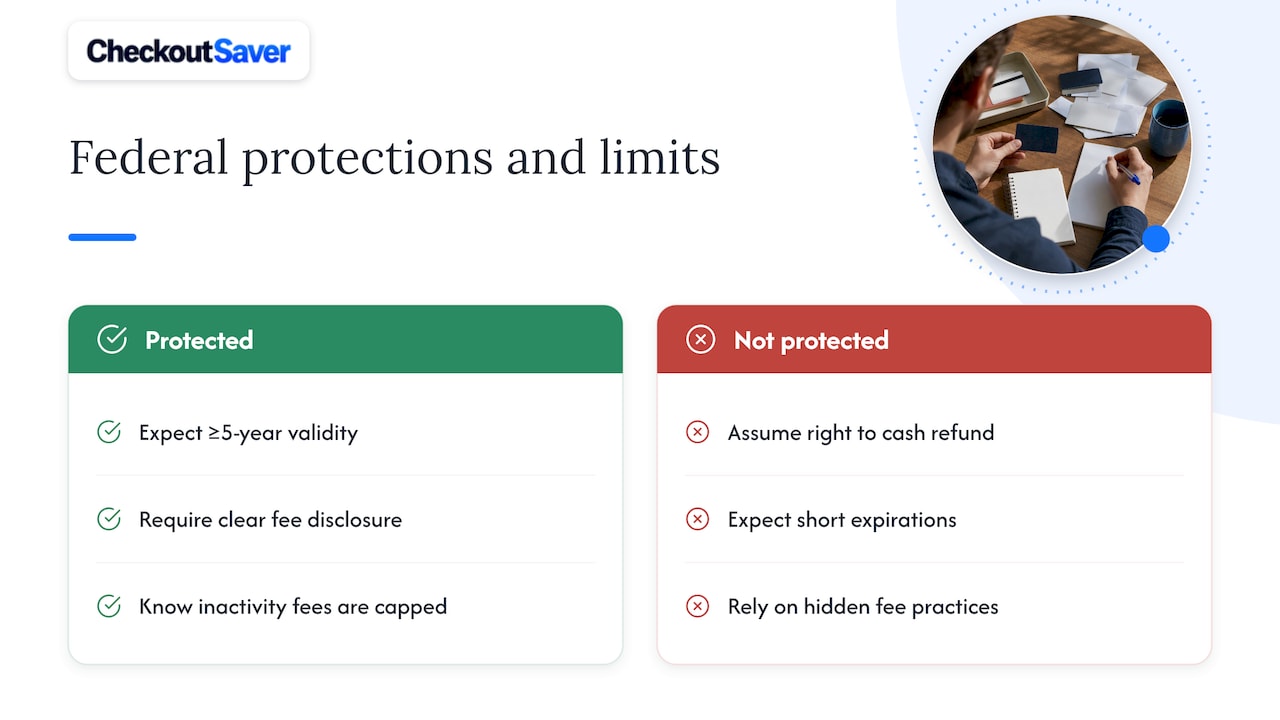
Federal law gives gift card holders real protection, just not the kind that guarantees your money back. Under the Credit CARD Act and its implementing rules, a gift card generally has to stay valid for at least five years from the date you bought it or the date you last added funds, and any inactivity fee has to be clearly disclosed and limited in how often it’s charged.
The federal rule: gift cards must remain usable for at least five years and dormancy fees are capped and disclosed, according to federal consumer finance guidance. That matters because it stops a store from quietly expiring your $50 balance after six months or bleeding it out with monthly fees.
What this protection does not do is force a retailer to refund a card you simply don’t want anymore. The law is about preventing a card from losing value through expiration or hidden fees, not about creating a right to return it for cash. If you bought a card, decided you didn’t need it, and the store’s policy says final sale, federal law won’t override that. The practical effect is that your balance stays usable and intact for years, which matters a lot if you plan to use the alternatives covered later.
State cash-out laws: when you can get cash for a small balance
Here’s the one real exception to “gift cards are final sale”: in several states, once a gift card’s remaining balance drops below a set dollar threshold, the retailer may have to pay you that balance in cash if you ask. Several states require this cash-out once the balance falls under a state-set limit, though the exact threshold and qualifying card types vary by state.

This only applies to what’s left on a card you’ve already been spending down. It is not a way to return a full, untouched $100 gift card for cash.
If you think you qualify, here’s the sequence:
- Check the remaining balance online, by phone, or using a gift card balance checker before you go to the store.
- Bring the physical card and the receipt, if you still have it, to support your claim.
- Ask a cashier or customer service directly for the cash-out, naming the balance and referencing your state’s law if needed.
- Escalate to a manager if front-line staff aren’t aware of the policy, since many clerks have never processed this request.
- Contact your state attorney general’s consumer protection office if the store refuses outright.
Pro Tip: Spend a card down intentionally if you’re close to your state’s threshold. Buying a $3 coffee on a $7 balance might tip you over the line into cash-out territory.
If the card was scammed, doesn’t work, or the store closed
Speed matters more than almost anything else here. If a scammer talked you into buying a gift card and reading off the code, your best odds come from acting within minutes or hours, not days.
- Keep the physical card and receipt. You’ll need the numbers on the back to prove ownership and timing.
- Call the gift card issuer immediately and tell them you were scammed, asking if they can freeze or reverse the balance.
- Report the scam to the FTC at ReportFraud.ftc.gov as soon as you’ve contacted the issuer.
- File a police report if the amount is significant or the scammer made specific threats.
The FTC advises contacting the issuer right away because some companies can freeze a balance if the scammer hasn’t yet downloaded or redeemed the funds. Timing is everything: a card that’s already been drained is nearly impossible to recover, while one that’s still sitting unredeemed has a real shot. The FTC’s guidance on what to do if you were scammed repeats the same advice: contact the issuer first, then report to the FTC.
If instead the problem is a card that simply doesn’t work at checkout, call the number on the back before assuming the worst. Many “dead” cards are fixable activation errors.
Store closures are a different animal entirely. When a retailer files for bankruptcy, gift card holders typically rank as unsecured creditors, behind secured lenders and other claims. Unless a specific exchange program gets announced, like when Bed Bath & Beyond agreed to accept Toys R Us gift cards during that chain’s wind-down, expect limited or no recovery.
Pro Tip: Photograph both sides of any gift card the moment you buy or receive it. If it’s ever lost, stolen, or part of a scam, you’ll have the numbers on hand instantly.
Practical alternatives when a refund isn’t on the table
When a store won’t give you cash back and you’re not near a state cash-out threshold, you still have real options for recovering value instead of letting a card sit unused.
- Sell it on a resale marketplace or at an exchange kiosk. Expect a payout below face value, since the buyer is taking on resale risk.
- Regift it to someone who actually shops at that retailer, which captures full value for them even if you never use it.
- Trade with a friend or family member for a card to a store you’ll actually use.
- Spend it down strategically on small purchases until you cross your state’s cash-out threshold, if one applies.
- Convert it through a marketplace built for that purpose. You can sell an unused gift card for cash rather than letting it expire in a drawer, or put the value toward a discounted gift card for a store you’ll actually use.
Smaller merchants sell gift cards too, and their terms follow the same logic. A coffee roaster’s e-gift card or a local florist’s gift card for online purchases will carry the same final-sale language as a big-box retailer, just with less fine print to dig through.
Why acting fast and keeping records beats hoping for a refund
The pattern across every recovery path, state cash-out, scam reversal, or resale, is the same: the people who keep their receipt, photograph the card, and call someone the same day do better than the people who wait a week. A frozen balance that hasn’t been redeemed yet is recoverable. A balance someone already drained usually isn’t.
Checking your balance before you act costs nothing and takes a minute, whether that’s a general balance checker or a retailer-specific one. Knowing the exact number before you call customer service or your state attorney general makes the conversation faster and harder to brush off.
— Justin
Turning an unwanted gift card into value you’ll actually use
If a refund isn’t realistic for your card, we built a faster route to the same result: real value back. We let you sell an unused gift card for a flat 15% fee instead of leaving it to expire, and we sell discounted gift cards to stores you’ll actually shop at, some payable with cryptocurrency.

That combination means a card for a store you never visit can become cash, or become store credit somewhere you will use, without you having to argue with a retailer’s return desk. Our pricing and fees are visible upfront, with no hidden codes or paywalled discounts, so you know what you’re getting before you commit. Start by checking what your card is worth, then browse discounted gift cards to put that value toward something you’ll actually use.
FAQ
Can I get a refund if I paid with a gift card?
Usually, any refund for an item bought with a gift card goes back onto that same card or a new one, not to your bank account or in cash. A small number of states require cash payouts, but only once a card’s remaining balance drops below a set threshold, as outlined in state gift card return rules.
Can I get a refund for a gift card itself?
Gift card purchases are almost always final sale, so you generally can’t return the card for your money back. The main exception is state cash-out laws that apply once a card’s balance is already low, not to a full, unused card.
What happens if I buy a gift card and it doesn’t work?
Call the number on the back of the card or the issuer’s customer service line first, since many non-working cards are simple activation errors rather than fraud. If the issuer can’t fix it, ask about a replacement or escalate the claim in writing.
Can I get money back if I was scammed with a gift card?
Contact the card issuer immediately and tell them you were scammed, since some issuers can freeze or reverse a balance if it hasn’t been redeemed yet, according to FTC scam-reporting guidance. Report the scam to the FTC at ReportFraud.ftc.gov as soon as you’ve contacted the issuer, since speed significantly affects recovery odds.
Sources
- Avoiding and reporting gift card scams | Consumer Advice
- Consumer Financial Protection Bureau (CFPB) — gift card guidance
- Can you return a gift card with a receipt? Rules & rights – LegalClarity