
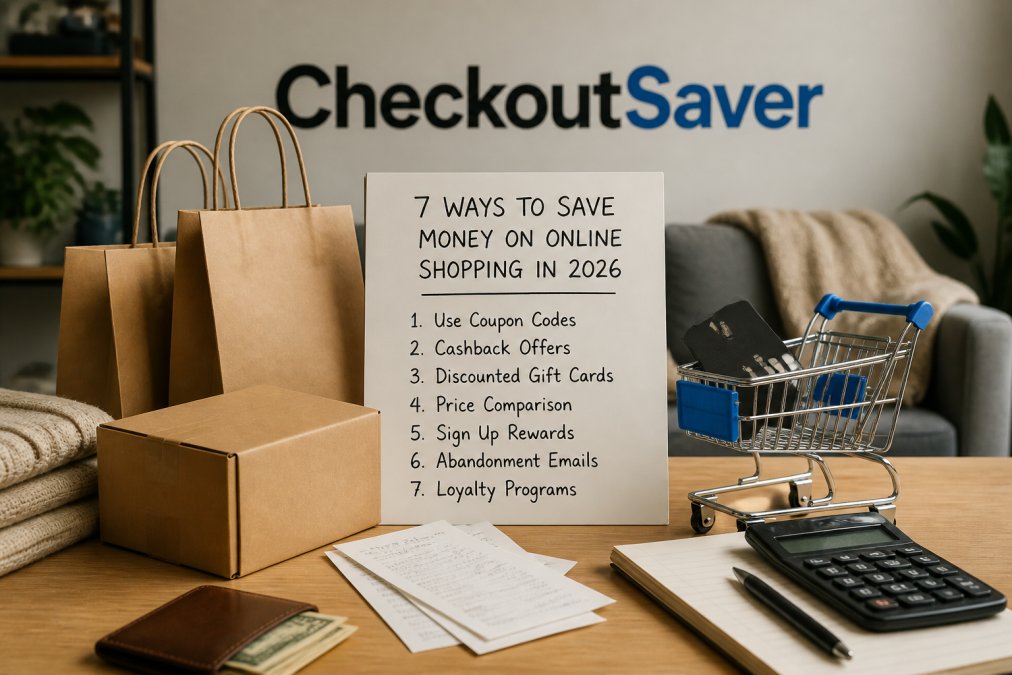
Table of Contents
- 1. Use Cashback Apps and Browser Extensions
- 2. Find Verified Coupon Codes Before You Check Out
- 3. Buy Discounted Gift Cards the Safe Way
- 4. Compare Prices With Tracking Tools
- 5. Time Your Purchases Around Sales Cycles
- 6. Recover Abandoned Carts and Use Sign-Up Incentives
- 7. Stack Credit Card Rewards and Loyalty Perks
- Frequently Asked Questions
Last Updated: September 14, 2026
1. Use Cashback Apps and Browser Extensions
Among the 7 ways to save money on online shopping in 2026, cashback apps and browser extensions are the fastest starting point because they work automatically once installed. The best cashback apps for online shopping credit a percentage of your purchase back to your account, and many stack with store sales you were already going to use.
A common mistake is installing three extensions that all try to claim the same transaction. Pick one primary cashback tool, then verify it actually activates before you pay. Checkout Saver takes a different route: instead of a single cashback rate, it bundles cashback with one-time use coupon trading and discounted gift cards, so you can combine savings methods rather than choosing one.

Before installing any extension, check what data permissions it requests. Many cashback tools read your browsing history across every site, not just retail ones. A privacy-first approach is to enable the extension only when you’re actively shopping.
2. Find Verified Coupon Codes Before You Check Out
Verified coupon codes are codes confirmed to work at a specific retailer within a recent window, not codes scraped from a forum years ago. Learning how to find verified coupon codes saves more time than testing a dozen dead codes at checkout.
The practical workflow looks like this:
- Search the retailer name plus “promo code” and check the date on each result
- Prefer codes marked as verified or user-tested within the last 30 days
- Test the code in a private browser window before committing to a cart
- Keep a note of which codes worked, since retailers recycle them
This is where Checkout Saver’s one-time use coupon trading model stands out. Instead of digging through expired listings, you trade codes that are confirmed single-use, which cuts down on the guesswork that plagues free coupon sites.
3. Buy Discounted Gift Cards the Safe Way
Discounted gift cards let you pay less than face value for credit you’ll spend anyway. Safe ways to buy discounted gift cards come down to three checks: buy from a platform with a buyer guarantee, confirm the card balance immediately after purchase, and keep the transaction record until the card is fully spent.
What most guides miss is the resale side. If you have unused gift cards sitting in a drawer, selling them recovers money you’ve already spent. Checkout Saver offers gift card buying and selling in one place, with what it describes as best rates on gift cards and no hidden codes, so the value you see is the value you get.
Never buy discounted gift cards from social media sellers or classified listings with no escrow. If the card was reported lost or stolen, the retailer can freeze the balance and you have no recourse (Avoiding and Reporting Gift Card Scams).
4. Compare Prices With Tracking Tools
Price comparison tools and price trackers show you what a product costs across retailers and how that price has moved over time. Dedicated tools like Capital One Shopping, Google Shopping, Price.com, and PriceGrabber each handle a piece of this: Capital One Shopping compares prices across stores and tests coupon codes automatically, Google Shopping aggregates listings with seller ratings, Price.com adds cash back and price alerts, and PriceGrabber focuses on straightforward merchant comparisons for electronics and home goods.
| Tool | Standout Feature | Best For |
|---|---|---|
| Capital One Shopping | Automatic coupon testing at checkout | Cross-retailer price checks |
| Google Shopping | Price history and seller ratings | Researching before you buy |
| Price.com | Cash back plus price alerts | One dashboard for savings |
| PriceGrabber | Clean merchant comparison | Electronics and appliances |
The gap most shoppers ignore is timing. A price tracker only pays off if you set a price drop alert and then actually wait.
5. Time Your Purchases Around Sales Cycles
Retail sales cycles repeat on a predictable calendar, and shopping during sales cycles beats hunting for codes after the fact. Flash sales, clearance events, and holiday promotions are when retailers cut prices directly, which stacks cleanly with cashback and gift cards.
A few patterns worth tracking:
- January, white sales on bedding and linens, plus post-holiday clearance on winter apparel and electronics
- February, Presidents’ Day weekend appliance and mattress promotions
- March-April, spring clearance on winter inventory, plus tax-season promotions on software and office gear
- May, Memorial Day weekend furniture, mattress, and outdoor promotions
- July, Prime Day-style events and competing retailer counter-sales, plus mid-summer clearance on spring apparel
- August-September, back-to-school pricing on laptops, dorm supplies, and small appliances
- Labor Day, mattress, appliance, and outdoor furniture markdowns
- October-November, early Black Friday rollouts that start weeks before Thanksgiving, plus Columbus Day and Veterans Day promotions
- Black Friday through Cyber Monday, the deepest storewide discounts of the year, with Cyber Monday skewing toward electronics and sitewide codes
- December, Green Monday and last-minute shipping-deadline sales, then post-Christmas clearance starting December 26
Retailer loyalty events often beat public sales for members. A common pattern is a members-only window that opens 24 to 48 hours before the public sale, with an extra percentage off or free shipping that non-members don’t see (Registration Information). If you’re already on a store’s free loyalty tier, watch your inbox the week before a known holiday weekend.
Set price drop alerts a few weeks before a known sale period so you’re not scrambling the day of. The mechanism that separates shoppers who actually save from those who just browse: pick the item, set the alert at your target price, and let the tracker notify you when the sale window opens. Then sequence the purchase, discounted gift card first, verified promo code second, rewards card for the remainder, so the sale price compounds with every other layer in this list.
Add the sale dates you care about to your phone calendar now, with a reminder two weeks ahead. The reminder is what turns a known sales cycle into an actual purchase at the bottom of the price curve.
6. Recover Abandoned Carts and Use Sign-Up Incentives
Abandoned cart emails and newsletter sign-up incentives are two of the least-used savings levers. Leave items in your cart for a day or two and many retailers send a discount to bring you back. Sign up for a store’s email list before your first purchase and you’ll often get a welcome offer applied to that order.
The timing matters more than most guides admit. A common pattern is a first abandoned-cart email within a few hours that contains no discount, a second email 24 hours later that includes a code, and a third email 48 to 72 hours after that with a slightly better offer or free shipping (Abandoned Cart Emails: Best Practices & Examples (2026)). If you’re going to wait, wait for the second or third message, the first one is usually just a reminder.
Sign-up incentives vary by retailer type. A few patterns worth knowing:
- Apparel and beauty, a percentage off your first order, often 10% to 20%, sometimes with a minimum spend
- Home and furniture, a flat dollar amount off, or free shipping on a first order above a threshold
- Subscription boxes, a discounted first box rather than a percentage off
- Marketplaces, a credit applied to your account rather than a code at checkout
The tradeoff is inbox clutter, and in 2026 it’s also a data tradeoff. Every sign-up hands the retailer your email, and often your phone number and browsing behavior. Two habits keep this manageable:
- Use a dedicated email address for retail sign-ups. Your primary inbox stays clean, and you can search that address when you need to find a welcome code you forgot to use.
- Audit and unsubscribe on a schedule. Once a quarter, scan that address for retailers you haven’t bought from in six months and unsubscribe. This is the same discipline that keeps subscription fatigue from quietly draining your budget, the recurring charges you forgot about cost more than the welcome codes save.
A privacy-first approach: before you hand over an email for a one-time welcome code, check whether the retailer requires marketing consent as a condition of the discount. Many do, and many let you opt out of third-party sharing separately. Take the extra click.
The single highest-return habit in this list is leaving a full cart overnight. It costs nothing, takes no setup, and retailers frequently respond with a discount code within 24 hours. Pair it with a dedicated retail email address so the savings don’t cost you your primary inbox.
7. Stack Credit Card Rewards and Loyalty Perks
Credit card rewards and loyalty programs stack on top of everything else when you sequence them correctly. Pay with a card that earns elevated rewards in the retailer’s category, then route the purchase through your cashback app, then apply any store loyalty points at checkout.
Stacking order matters:
- Start with the discounted gift card or store credit
- Apply the verified promo code
- Pay the remainder with a rewards card
- Let your cashback extension record the transaction
Membership perks and store credit are the most overlooked layer. Many retailers offer free loyalty tiers that unlock member-only pricing, and that discount applies before any code.
The 7 ways to save money on online shopping in 2026 only compound when you stop treating each method as a separate errand. The shoppers who save the most aren’t clipping more coupons, they’re sequencing the same five or six tactics in the right order. Checkout Saver was built for exactly that: one-time use coupon trading so you never buy a dead code, discounted gift cards with what the platform calls the best rates, and cashback that lands in your pocket rather than a points balance you’ll never redeem. Sign up free and start stacking.
Frequently Asked Questions
How does cashback shopping work for online purchases?
Cashback platforms partner with retailers and share a portion of the sale commission with you. You click through the cashback site or use its browser extension before buying, and the retailer tracks the purchase. Once the transaction clears the return window, your cashback becomes payable. Rates vary by retailer and category, typically ranging from 1% to 15%. Some platforms pay via PayPal, bank transfer, or gift cards. The key is starting your shopping session through the cashback link every time.
How can I verify if an online coupon code is legitimate?
Stick to sources that show community verification or success rates. RetailMeNot, for example, uses shopper feedback to flag working codes. Check the expiration date and any minimum purchase requirements before applying. If a code fails at checkout, try a different one rather than abandoning the cart. Avoid codes from unfamiliar sites that ask for personal information or payment to reveal the code. Legitimate coupon codes never require you to pay for access.
Are discounted gift cards a safe way to save money?
Buying discounted gift cards is safe when you use a platform that verifies card balances before listing and offers a guarantee if the card does not work. Checkout Saver verifies cards and provides a no-hidden-code experience. Avoid buying gift cards from strangers on social media or classifieds, where scams are common. Stick to established platforms that hold funds until the card is confirmed working, and always check the card balance immediately after purchase.
What is the best way to track price drops on items I want to buy?
Use price tracking tools like Google Shopping, Price.com, or Capital One Shopping. These tools monitor product prices across retailers and send alerts when the price drops. Set a target price and let the tool notify you. For bigger purchases, track prices for two to four weeks to understand the normal price range before buying. Buying during flash sales or clearance events can save 20% to 50% off the regular price.
What are the most effective ways to save money while shopping online in 2026?
Stack multiple savings methods: start with a cashback app, apply a verified coupon code, pay with a discounted gift card, and use a credit card that offers rewards on that category. This layering approach can cut 15% to 30% off your total. Also time purchases around major sales cycles like Memorial Day, Labor Day, and Black Friday. Set price drop alerts for items you want but do not need immediately.

