Issuers can and do change cashback rates or categories, and the CFPB has flagged this practice as worth consumer attention, while a marketplace like Checkout Saver gives you a fast way to recover lost value. The single most important move you can make right now is to open your most recent issuer notice and compare it against your rewards terms before any grace period closes.
TL;DR:
- Check statement messages, mailed or emailed notices, and both rewards documents; advance notice may be around 45 days, but timing depends on the change.
- If a program changes or ends, redeem your existing balance before its stated forfeiture deadline, which may appear in a separate rewards guide.
- A lower rate on future purchases is generally permitted, but retroactively reducing earned rewards or unexpectedly worsening redemption terms may warrant a documented CFPB complaint.
- A grocery bonus falling from 5% to 1% costs $12 monthly, or $144 yearly, on $300 monthly spending; compare that loss with alternatives.
- Statement credits preserve cashback’s full face value, while gift card redemptions may use a worse exchange rate, so compare redemption terms before choosing.
Table of Contents
- What cashback programs are and how the main types work
- Why issuers change cashback rates and categories
- How a rate change actually shows up: notices, timing, and deadlines
- How to calculate what a rate change actually costs you
- Your action checklist: the first 90 days after a rate change
- How Checkout Saver and transparent marketplaces help offset a rate cut
- When to accept a cashback change and when to push back
- Start recovering value: where to go on Checkout Saver
- FAQ
- Sources
What cashback programs are and how the main types work
Cashback is a percentage of your purchase returned to you, usually as a statement credit, direct deposit, or sometimes a check or gift card. The mechanics behind that percentage vary a lot by card, and the type you hold determines how exposed you are when an issuer decides to adjust it.
Most cashback cards fall into a few main types:
- Fixed-rate cards pay the same percentage on every purchase, typically a low single-digit rate, with no categories to track.
- Category-based cards pay a higher rate on specific spending categories like groceries, gas, or dining, with a flat rate on everything else.
- Rotating-category cards change which categories earn bonus cashback every quarter, often requiring manual activation.
- Hybrid cards combine a fixed base rate with occasional bonus categories tied to promotions.
Issuers credit cashback after a transaction posts and clears, and most programs let you redeem earnings once you hit a minimum threshold, sometimes as low as $25, though the figure is set by each issuer and appears in your rewards terms rather than in any universal rule. Redemption paths typically include statement credit, direct deposit, a check, or conversion to gift cards, and the method you choose can change the real value of what you earn, since some issuers apply a less favorable exchange rate to gift card redemptions than to cash.
This complexity is part of what regulators have started paying closer attention to. The CFPB has noted that rewards programs can obscure how much a reward is actually worth, especially when redemption options or category structures shift without the cardholder noticing. A category-based card that quietly drops a bonus category, or a rotating-rewards card that skips a quarter you relied on, can cost you real money if you’re not tracking the terms. Knowing which type of cashback card you hold is the first step to understanding what a “rate change” notice actually means for your wallet.
Why issuers change cashback rates and categories
Cashback programs are funded largely by interchange fees and merchant partnership deals, not goodwill. When merchant agreements get renegotiated or the cost of funding a rewards program rises, issuers adjust the generosity of their offers to protect margin. A bonus category rate can shrink from one level to a lower level the next year simply because the underlying merchant deal changed, and the issuer is rarely required to explain the business reason in plain language.
Issuers also build the right to make these changes directly into the paperwork you agreed to when you opened the account. A sample cardholder agreement shows the kind of clause that is standard across the industry: issuers reserve the right to add, delete, or change terms, including benefits like cashback rates, and they may do so through a statement message, a mailed notice, or a posted update rather than a dedicated letter.
We may change the terms of this Agreement, including fees, rates, and other terms, at any time.
That kind of clause is common because rewards programs are, legally, promotional benefits layered on top of a credit agreement, not a fixed contractual promise. The protection consumers have comes less from the fine print and more from regulatory scrutiny of how changes are communicated and applied.
The CFPB’s December 2024 circular warns that devaluing already-earned rewards, or changing redemption terms in ways consumers can’t reasonably anticipate, may cross into unfair or deceptive territory. That distinction matters: changing the rate on future purchases is standard business practice, but stripping value from cashback you already earned is a different story, and it’s the part regulators are watching most closely.
The circular also points to rising consumer complaints about devaluation tactics, including redemption options that disappear or point values that drop without clear notice. If you’ve already earned a cashback balance under the old terms, that balance generally shouldn’t be retroactively devalued, and if it is, you have grounds to push back, document the change, and escalate if the issuer won’t fix it.
How a rate change actually shows up: notices, timing, and deadlines
A cashback rate change rarely arrives as a surprise if you’re reading your mail and statements. It shows up through a handful of predictable channels, and knowing where to look saves you from missing a deadline.
- Check your statement messages first. Many issuers announce rate or category changes through a line item on your paper or online statement before sending any separate letter.
- Look for a mailed or emailed change-in-terms notice. Depending on the type of change, issuers commonly give advance notice, sometimes around 45 days, though the exact window depends on the specific term being changed and the issuer’s own policy.
- Note the stated effective date. Changes tied to variable rates or indexes, as shown in a sample credit card agreement, often take effect at the start of the next billing cycle after a set date rather than immediately.
- Watch for “continued use equals acceptance” language. Many agreements state that using the card after the effective date counts as agreeing to the new terms, so closing or not using the card are your main ways to opt out if you disagree.
- Search both the main cardholder agreement and a separate rewards guide. Some issuers house the redemption deadlines and forfeiture rules in a distinct document, so a term you’re looking for might not be in the agreement you already have saved.
The most urgent thing to find is the deadline for redeeming any cashback you’ve already earned under the old terms. Some issuer agreements, including a sample cash back program document, set a short redemption window after a program changes or ends, after which unredeemed balances can be forfeited. If your notice mentions a program change, redeeming what you’ve earned before that window closes should be your first move, not an afterthought.
How to calculate what a rate change actually costs you
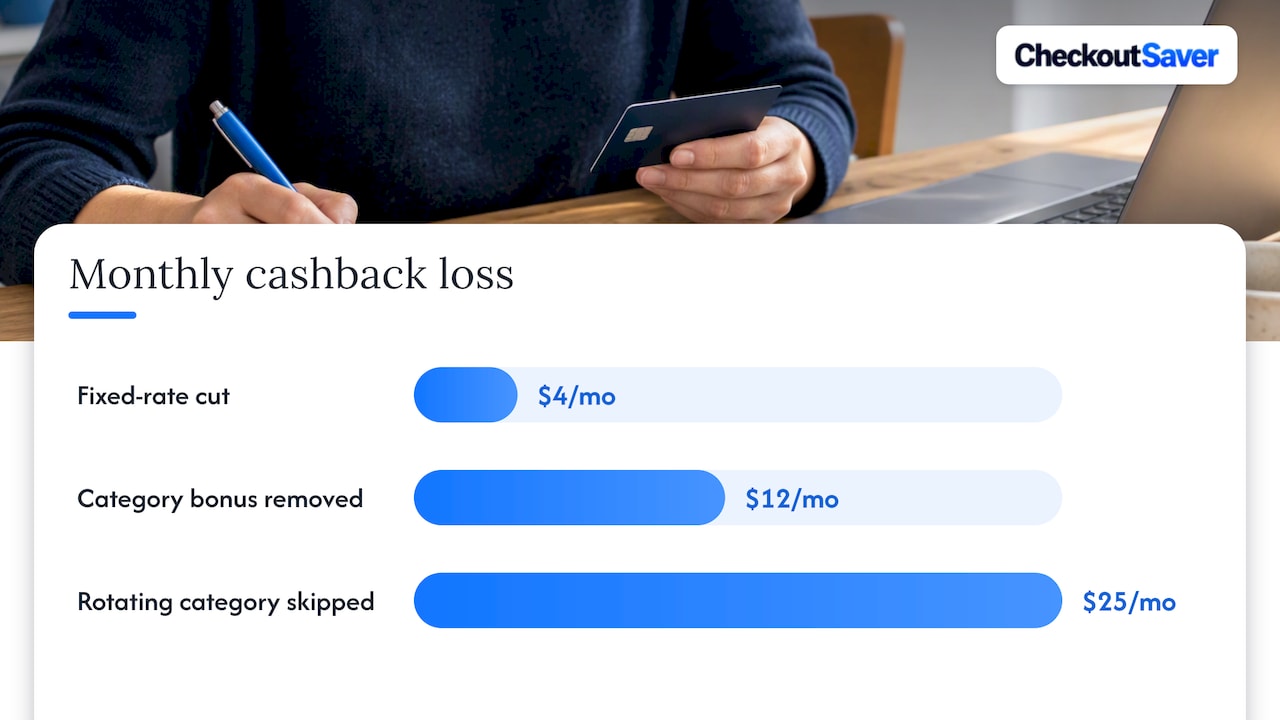
The math behind a cashback rate cut is simple once you have three numbers: your monthly spend in the affected category, the old rate, and the new rate. Multiply spend by the rate to get monthly cashback, then subtract the new total from the old one to see your loss.
Pro Tip: Always factor in the redemption method when you value a loss. A statement credit is worth its full face value, but some issuers apply a reduced exchange rate when you redeem cashback for gift cards instead of cash, which can make an already-smaller reward worth even less.
Here are three scenarios using simple assumptions, labeled clearly as illustrative math rather than any single issuer’s actual terms:
| Scenario | Monthly spend | Old rate | New rate | Monthly loss | Annual loss |
|---|---|---|---|---|---|
| Fixed-rate cut | $800 | 2% | 1.5% | $4.00 | $48.00 |
| Category bonus removed | $300 (groceries) | 5% | 1% (default rate) | $12.00 | $144.00 |
| Rotating category skipped | $500 (one quarter) | 5% | 0% (not activated) | $25.00 | $100.00 (one quarter) |
A half-point drop on everyday spending sounds minor until you annualize it, and a dropped category bonus on a high-spend area like groceries can cost more than ten times as much per year as a small fixed-rate cut. The rotating-category scenario is worth separating out because the loss is one-time per quarter rather than ongoing, which changes how urgently you need to respond.
These numbers also show why the redemption method matters as much as the rate itself. A $144 annual loss redeemed at full statement-credit value is a clean $144. The same loss redeemed through a gift card program with a reduced exchange rate could mean the real dollar impact is higher than the headline percentage suggests.
Your action checklist: the first 90 days after a rate change
Speed matters here. The gap between noticing a change and acting on it is usually where consumers lose redeemable value, so work through these steps in order rather than all at once.
- Confirm the change in writing. Pull up the actual notice, whether it’s a statement message, email, or letter, and match it against the current rewards terms on the issuer’s website or portal.
- Redeem any at-risk balance immediately. If the notice mentions a program change or termination, check for a forfeiture deadline and redeem before it passes.
- Save a copy of every communication. Screenshot statement messages, save emails, and keep a dated record in case you need to dispute anything later.
- Recalculate your card’s value for your actual spending. Use the formulas above against your real monthly spend to see whether the card still earns more than a competing option would, independent of brand loyalty.
- Shop for a replacement only if the math no longer works. Compare based on category fit, minimum payout threshold, and redemption flexibility rather than headline rate alone.
If you shop across categories like electronics or apparel where pricing varies by region, it’s also worth checking that you’re not losing value to currency markups on top of a cashback cut. A guide to paying in local currency when shopping internationally covers a related leak in rewards value that often goes unnoticed.
How Checkout Saver and transparent marketplaces help offset a rate cut
When a cashback rate drops, the fastest way to recover lost value isn’t always to switch cards. It can be to stack a transparent savings channel on top of whatever you’re still earning. We built our marketplace around that idea: discounted gift cards, one-time-use coupons, and cashback rewards at thousands of stores, combined with a referral community, without hiding codes behind a paywall the way many competing coupon sites do.
- We list discounted gift cards across a wide range of retailers, which lets you buy below face value instead of relying on a cashback rate alone.
- We support purchasing gift cards with cryptocurrency, which can stack additional savings for shoppers already holding crypto.
- We offer one-time-use coupons alongside cashback, so a single purchase can combine multiple savings layers instead of depending on one rewards rate.
- We keep our cashback percentages competitive by running a leaner operation than many mainstream rewards platforms, which is a direct result of lower overhead.
Here’s how that stacks up against the grocery scenario from earlier: a $144 annual loss from a dropped category bonus is a real hit, but if even a portion of that grocery-adjacent spending shifts to a retailer where a discount gift card is available below face value, combined with a one-time coupon, the combined savings can meaningfully close that gap over the course of a year. The exact recovery depends on where you shop and how much of your spend you’re able to redirect, but the structure of combining a discount, a coupon, and cashback in a single purchase is what makes the difference, not any single feature on its own.
For readers managing electronics purchases specifically, a buyer’s guide to maximizing online deals covers category-specific strategies worth pairing with any gift card or coupon stack.
When to accept a cashback change and when to push back
Most rate changes are just business, not malice. Issuers reprice rewards when merchant funding shifts, and a lower rate on future purchases is a normal part of how these programs stay solvent. I’d save your energy for the cases that actually warrant it: when a balance you already earned gets devalued, when a program disappears with little notice, or when the redemption options quietly get worse without any clear explanation.
Realistically, disputing a straightforward rate cut rarely gets you anywhere, issuers are within their contractual rights to do it. But disputing a retroactive devaluation of rewards you’ve already banked is a different fight, and it’s the one the CFPB has signaled it takes seriously. If you’re in that situation, document everything and escalate quickly.
Either way, speed is the variable you control. The faster you redeem at-risk balances and start routing some spending through alternative savings channels, the less a rate change actually costs you over a year.
— Justin
Start recovering value: where to go on Checkout Saver
If a rate cut just ate into your rewards, the fastest fix is stacking savings somewhere transparent instead of waiting for your next card decision. We make that easy to start with just a couple of pages.

- Check our cashback hub to see current rates before you shop anywhere else.
- Create a free account to track savings and join the referral community at no cost.
| Next step | Where to go | What it solves |
|---|---|---|
| Compare current rates | Cashback hub | Lets you see rates before committing spend |
| Pay with crypto | Crypto gift card checkout | Adds a payment option for crypto-holding shoppers |
Once you’ve redeemed what’s at risk on your current card, browsing our gift card selection takes less time than reading a new rewards agreement, and it starts saving you money on your very next purchase.
This article is general information, not a substitute for advice from a qualified financial advisor. Consult a qualified financial professional about your own circumstances before acting on anything here.
FAQ
What card has the highest cash back rate?
Cashback rates vary widely by issuer and category, and the highest rate on any given card often applies only to a specific rotating or bonus category rather than all spending. Check your issuer’s current rewards terms directly, since rates change, and compare the category fit to your own spending before assuming a high headline rate applies to you.
How do I use my cashback money?
Most issuers let you redeem cashback as a statement credit, a direct deposit, or sometimes a check, and some also offer gift card conversion. Statement credit typically preserves full value, while gift card redemption can apply a different exchange rate, so check your specific program’s redemption terms before choosing.
What does 6% cashback mean?
A 6% cashback rate means you earn six cents back for every dollar spent in the category the rate applies to, usually a specific bonus category rather than all purchases. These elevated rates are often tied to a rotating category, a promotional period, or a spending cap, so the rewards terms will specify exactly where and how long the rate applies.
How do I know if my cashback rate actually changed?
Check your most recent statement messages and any mailed or emailed notice from your issuer, then compare the stated rate or category against your current rewards terms. If you can’t find a clear change notice, call your issuer directly and ask for written confirmation of your current rate.
What should I do if my issuer lowers my cashback rate?
Redeem any cashback balance you’ve already earned before a forfeiture deadline passes, then recalculate whether the card still fits your spending at the new rate. If the change affected rewards you’d already earned rather than just future earnings, consider filing a complaint with the CFPB.
Recommended
- Cashback vs Discounts for Shoppers & Marketers: 8 Factors + Hybrid
- How Cashback Works: Earn Real Cash Back Online Shopping
- How Cashback Works | Earn Real Cashback Shopping Online | Checkout Saver